
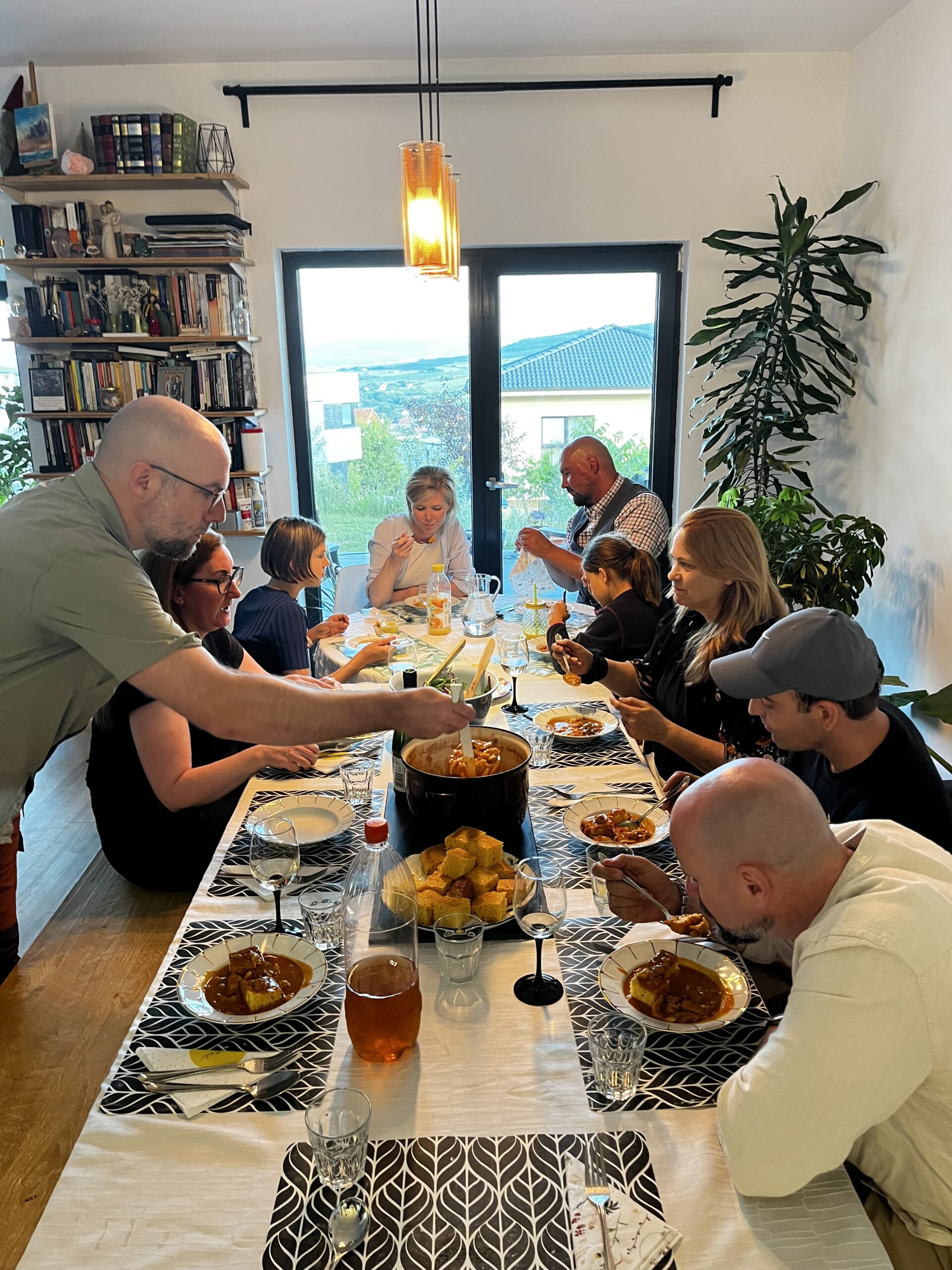
I have worked on this topic for a long time. I’m re-polishing a talk fit a certain context. At some point I had two different directions, both valid and powerful. But my heart is on simplifying it. Too much information crowds the heart.
In 2005 I was in college and I traveled to the United States by myself, with Work & Travel. (I was a migrant worker… But not really)
I was welcomed by friends and I have been on the receiving end of hospitality from a country, a culture, and a church in a way that shaped my perspective forever.
Two decades later I still draw from that generosity that I was met with in a time of need.
I have experience with hospitality as a guest, needing a place to lay my head on a pillow after a long train or plane ride, for a night or for a few months in a foreign city or country, and as a student longing for a home cooked meal.
I remeber so vividly the tiredness and hunger on the receiving end of rest and nourishment that I have decided to host and feed various people passing through our lives.
I don’t do it to impress anyone or to receive anything in return.
I do it because I too was once hungry and tired.
Hospitality has there dimensions:
– shelter,
– an open table and
– intelectual welcome.
And all three require the host to adapt. To be open, observant, flexible.
Hospitality happens best when offered with humility.
We need humility because there is something in the needful other
that tempts us to offer advice and direction.
Overestimating our understanding of the other and their circumstance,
we start cooking up ways to fix the challenges they face
and we end up crowding them.
Simple availability and attentiveness almost always accomplishes more
than crusades of advice and direction.
Author Margaret Guenther observes, “At its simplest,
hospitality is a gift of space, both physical and spiritual,
and like the gift of attentive listening, it is not to be taken lightly”
Let us consider: What do hospital and hospitality have in common?
While hospitalitem (as in hospitality) means “friendliness to guests”.
The word Hospital is a borrowed word from Latin hospitālis (via French),
in which it referred to sheltering people.
Later on, a hospital was a place where you stayed while ill
(as opposed to receiving treatment at home).
The root of Latin hospitālis is hospes, which meant both host and guest in Latin.
As I mentioned earlier, the first dimension of hospitality is shelter.
– a place giving temporary protection from bad weather or danger.
To offer hospitality is to offer Sanctuary. A holy refuge.
(because sanctus in latin means holy).
The second aspect is an open table
which does not mean a three course meal.
It’s basic nourishment. It’s breaking bread. Sharing what you have.
While giving people food is charity,
welcoming them to your table to break bread with you is creating community.
Hospitality involves not just giving welcome and comfort, but a little of yourself as well.
A verse (from Rev 3:30) comes to mind when I think of an open table.
Jesus says: “behold I stand at the door and knock.
If anyone hears my voice and opens the door,
I will come in and dine with him and he with me”
He doesn’t barge in. And Jesus does not come hungry.
He doesn’t come in to deplete our groceries or our winter supply.
He comes in to share, the bread of life, the living water.
If we welcome Him in
he is the one who offers us hospitality through conversation. The third aspect.
Amy Oden says that “…Hospitality is not so much a singular act of welcome
as it is a way, an orientation that attends to otherness,
listening and learning, valuing and honoring.”
When the war in Ukraine started, over three years ago,
without much time to think the situation through,
everyone in my city seemed to step up and help however they could.
through donations, meals, shelter, transportation.
The resources seemed to multiply, and once we spent our finances to support the refugees,
more donations would come through from unexpected sources.
To that point, Pohl writes, “Over and over again, I’ve come to see that
in God’s remarkable economy, as we make room for hospitality,
more room becomes available to us for life, hope, and grace”
Hospitality rolls up its sleeves and gets involved,
but it is careful not to mess with people.
It accepts them and values them as they are.
People view hospitality as quaint and tame, right?
partly because they do not understand the power of recognition.
When a person who is not valued by society
is received by a socially respected person or group as a human being,
with dignity and worth, small transformations occur…
Because such actions are countercultural, they are a witness to the larger community,
which is then challenged to reassess its standards and methods of valuing.
Many people who are not valued by the larger community are essentially invisible to it.
Hospitality can begin a journey toward visibility and respect.
Orphans are most often invisible. Refugees can be invisible.
Homeless people are invisible and ignored.
But Deut.10:18 says “God doesn’t play favorites, takes no bribes,
makes sure orphans and widows are treated fairly,
takes loving care of foreigners
by seeing that they get food and clothing.”
For sure our society had mixed feelings towards the refugees.
I have observed the fear of resource depletion, or the common complaint:
“we have plenty of our own who need help,”
The hospitable in our midst tuned out the negative voices,
and kept doing what they knew was right.
and the society at large was influenced to view refugees in a friendly light.
In Desmond Tutu’s words, “Those with eyes to see will know that these are brothers and sisters created by the same God and living as mutual guests
in the same house provided by the same divine host”
Hospitality is founded on the attitudes of goodwill, respect, and courage,
which set the stage for meaningful connection between strangers,
and it is brought to life through the skills of
noticing, listening, and creating space.
Goodwill identifies with the other.
A spirit of goodwill and respect keeps open the door of opportunity,
but something more is required if we are to walk through it,
and that is courage.
Hospitality is, after all, risky business, and it takes courage to set it in motion.
It is a calling that enables the innately brave to shine,
but where do the rest of us find this strength?
Sometimes we find it in the example of others.
The ROM community is a prime example for such inspiring stories.
We see them standing tall and are inspired to do the same.
Or we witness some form of injustice and, fueled with indignation,
reflexively move into action.
Oden writes, Hospitality is characterized by a particular moral stance in the world
that can best be described as readiness…
Whether we are guest or host, we must be ready,
ready to welcome, ready to enter another’s world,
ready to be vulnerable…This readiness is expectant…
Such readiness takes courage, gratitude, and radical openness.
And in Radical Hospitality, the authors observe, “Listening is always involved in hospitality. The most gracious attempts we can muster are meaningless
if we do not actually hear the stranger. Listening is the core of hospitality”
Yet Fully attentive listening is out of the ordinary.
Often we listen half-heartedly,
acting as if we are tuned in when in fact our mind is somewhere else.
My personal experience with hospitality is tightly knit with adopting children.
Food and shelter are not enough to make a difference.
Emotional connection is practiced through intellectual welcome,
and this ultimately brings forth change. A change one can adapt to or resist.
Hospitality requires flexibility and a certain amount of resistance through clear boundaries.
Effective boundary management generates a environment of safety.
A sense of safety, of course, is fundamental to all relationships.
While practicing hospitality we:
- Help each other:
- Double-check for clarity:
- Seek and grant forgiveness:
- Practice reciprocity: because we will be awkward givers if we are reluctant receivers.
Nouwen also warned about unbalanced relationships. “When only one gives and the other receives,
the giver will soon become an oppressor and the receivers, victims”
Henri Nouwen wrote, “The paradox of hospitality is that it wants to create emptiness,
not a fearful emptiness, but a friendly emptiness
where strangers can enter and discover themselves as created free;
free to sing their own songs, speak their own languages, dance their own dances;
free also to leave and follow their own vocations.
Hospitality is not a subtle invitation to adopt the life style of the host,
but the gift of a chance for the guest to find his own.”
Truly hospitable people do not treat us like we are special;
they treat us like we belong. It’s refrigerator privileges
and the blunt expectation that we will pick up after ourselves.
In this instance as well, hospitality is not just about providing shelter, and an open table but it’s also emotional and intelectual hospitality.
How does this subject fit with the theme of our conference?
Do we adapt to becoming more hospitable to people in need?
Climate refugees, war refugees, homeless, human trafficking victims, orphans and widows?
Hospitality is not as tame after all. Even though it all boils down to comfort.
How much are we willing to sacrifice
in order to accommodate the other.
Wisdom is required when you open your heart
your mind, your home and your table.
Because just like with intellectual welcome,
you provide safety and comfort and nourishment to a sojourner
but you are not relinquishing your keys to let them move in.
You still have autonomy and authority over your life.
To open your mind does not mean abandoning your values and believes
in order to adopt another’s point of view.
How can we practice hospitality in conversations?
How can we enlarge our mental space to make room for others to engage in conversations?
How are we inclined to adapt or resist in this process?