
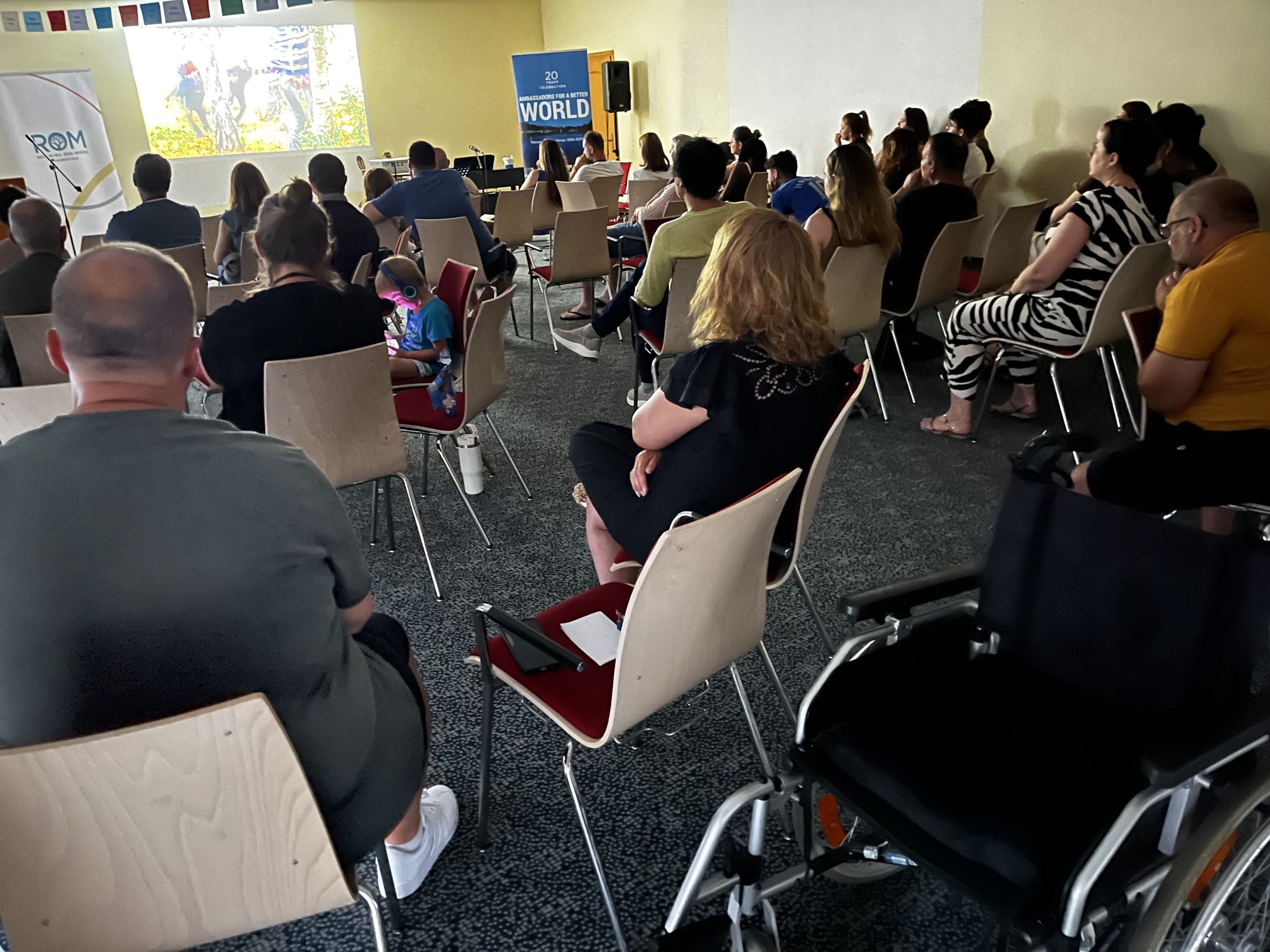
After the morning session I had 5 minutes to set expectations regarding the movie night and discussion afterwards. It was actually perfect. I often worry about the wrong expectations as it can sabotage even a great event.
So I said that the film is inspired by the true story of Izidor Ruckel. Abandoned as a baby after contracting polio, he spent his childhood in one of Romania’s state-run orphanages. After the 1989 Romanian Revolution, Western journalists revealed the suffering of thousands of children hidden away in these institutions. At age eleven, Izidor was adopted by a U.S. family. He later
became a powerful advocate for vulnerable children and people with disabilities, using his story to bring hope and change around the world.
And then I showed them the official trailer on izidorstory.com
Fot the evening I set the chairs in circles in advance and did another short introduction before starting the movie. I told them that I love to set expectations and reminded them to Commit to confidentiality, to Refrain from offering unsolicited advice. Avoid trying to give the “right” answers; focus more on giving “honest” answers. Transparency will make your time richer and more effective. And it goes without saying that they should not film any portions of the movie.
To warm up the small groups I gave them a few minutes to discuss two questions: What’s your go-to comfort food when you’ve had a rough day?
Who is one person or place that always makes you feel like you belong?
Then we played the movie. What a present and attuned audience we had!
The silence after the movie was interrupted only by sniffles. It was hard to break the spell. But break I did. With some reflective questions, like What were you feeling as you watched the story of Izidor? or What was the most powerful or memorable part of the film for you? Which inspired a few people to share with me at the end of the screening.
Then we talked about the three main themes: Belonging, Courageous kindness and Hope.
What is belonging and how does Izidor experience belonging?
In what ways are “belonging” and “fitting in” different? What connection do you find between a person’s identity and their sense of belonging? Belonging and fitting in may look similar on the surface, but they’re very different experiences. Fitting in means changing or hiding parts of ourselves to be accepted, which leads to shallow connections because others only see the version that conforms. Belonging, on the other hand, is about being seen and valued as we truly are, without needing to pretend or perform. While fitting in depends on sameness, belonging grows out of authenticity, creating spaces where people feel safe, accepted, and connected.
Kindness is different from being nice. Kindness takes courage because it costs us. It requires personal risk with no guarantee of reward.
Onisa and Izidor’s journey shows us what can happen when we change our
focus from trying to solve a “problem” to seeing a “person.” Onisa doesn’t see
a room full of faceless “irrecoverable children.” She sees a little boy and moves to serve that one child. She didn’t change his circumstances, but she gave him something that changed his life: hope.
Psychologists have found that hope is essential for overcoming life’s struggles. Research shows that hopeful thinking is one of the most important foundations of success—more important than intelligence, skill or previous success. Best of all, hope is a “learned response,” so anyone can embrace it for change.
I got to share some inside knowledge and hope, while using few but poignant words and phrases, to catch the audience attention. Sometimes big words escape my lips, but simplicity did the trick, especially in a diverse group where English is not their first language.
I was honored to bring Izidor at ROM.