
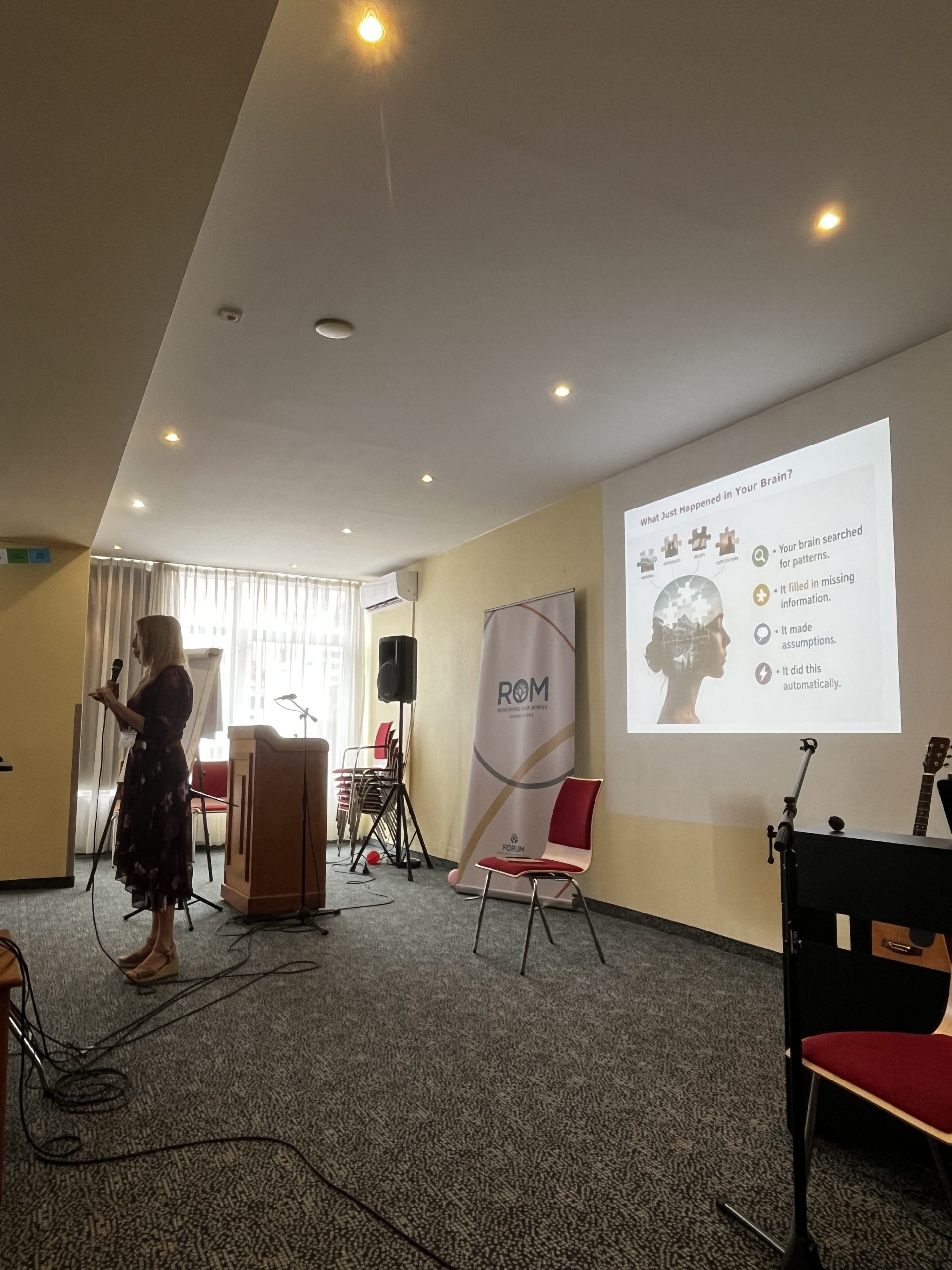
Noemi M challenged us to think of someone we met recently, maybe our first day at ROM. Before they spoke, what did we notice first?
- Their age?
- Their clothes?
- Their accent?
- Their gender?
- Their confidence?
- Their appearance?
What assumptions did we make about this person before they even spoke?
Did this person immediately feel like “someone like me” or “someone different from me”? Why? What are the origins of implicit bias?
Cognitive Processes: The role of heuristics, stereotypes, and categorization in forming implicit biases.
A heuristic is a mental shortcut or “rule of thumb” that allows people to make quick, efficient decisions or solve problems without extensive deliberation. It acts as an intuitive guide when finding a strictly rational or optimal solution is too time-consuming.
Socialization and Cultural Influences. How biases are acquired through upbringing and societal conditioning: Cultural influences, Media representations, Socialization Childhood experiences, Education, Trauma.
Water Lipmann’s: 4 Functions of stereotypes
- A shortcut
- A map of the world
- An ordering process
- Expression of values-beliefs
Walter Lippmann: Public Opinion, “The Pictures inside our Heads” and Stereotypes.
Draw three circles and place people or groups in them:
- Inner circle: People I feel comfortable with and know well.
- Middle circle: People I rarely interact with.
- Outer circle: People I know very little about or find unfamiliar.
Questions
1. Who is one person or group that you understand less than you could?
2. What question could you ask instead of making an assumption?
3. What is one small step you can take to replace bias with curiosity?
Reflect on Your Own Context
- Can you think of a group in your country, community, or workplace that is often described using stereotypes or negative labels? How might these messages shape the way people see that group?
• What early signs of polarization do you notice in your own context, and what can individuals or organizations do to challenge stereotypes before they lead to prejudice or discrimination?